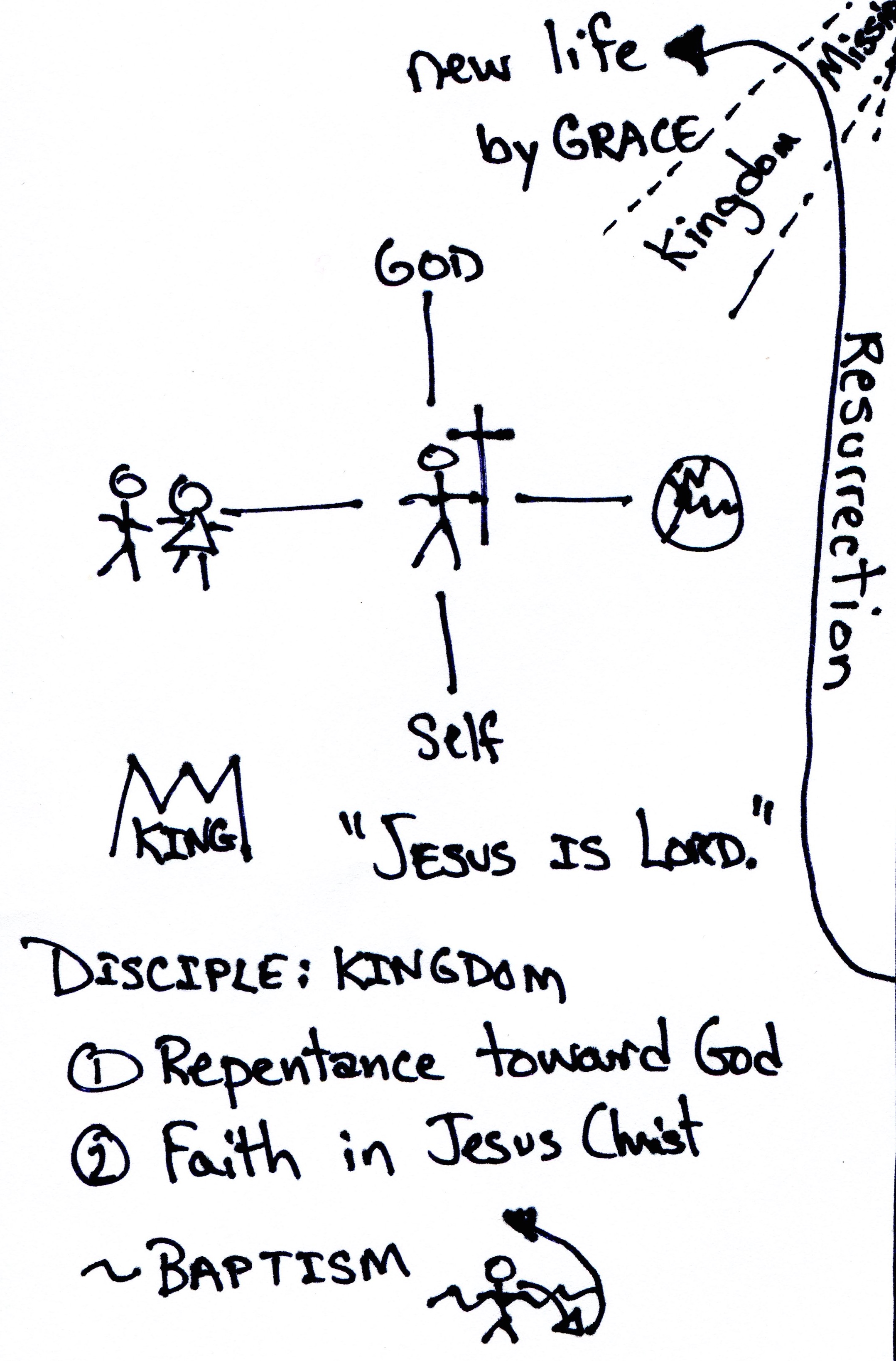
Your love choice.

IMG_7907

15The Lord God placed the man in the Garden of Eden to tend and watch over it. 16But the Lord God warned him, “You may freely eat the fruit of every tree in the garden—17except the tree of the knowledge of good and evil. If you eat its fruit, you are sure to die.” Genesis 2:15-17

This tree of the knowledge of good and evil appears to be the problem when we look back through the lens of our suffering and evil. Why did God do this? The tree is the hinge on which love turns. God created humanity with capacity and opportunity to choose love. So it is with the “image of God.” Love maintains a mixture of awe and respect with trust. Love cherishes the other. Love enters communion. These are all choices. Without “the tree” there are no choices and humanity resides in the garden as automatons, puppets on a string, acting only within a predetermined script.

Just as relationship within the communion of God is dynamic; so relationship between God and those who bear His image is dynamic.

Love for God is to live in respect to God with trust in Him and in His Word. The image of God has been bestowed on us and with it comes both capacity and responsibility to choose.

Relationships without shame.

IMG_2117

18Then the Lord God said, “It is not good for the man to be alone. I will make a helper who is just right for him.” 19So the Lord God formed from the ground all the wild animals and all the birds of the sky. He brought them to the man to see what he would call them, and the man chose a name for each one. 20He gave names to all the livestock, all the birds of the sky, and all the wild animals. But still there was no helper just right for him.

21So the Lord God caused the man to fall into a deep sleep. While the man slept, the Lord God took out one of the man’s ribs and closed up the opening. 22Then the Lord God made a woman from the rib, and he brought her to the man.

23“At last!” the man exclaimed.

“This one is bone from my bone,

and flesh from my flesh!

She will be called ‘woman,’

because she was taken from ‘man.’”

24This explains why a man leaves his father and mother and is joined to his wife, and the two are united into one.

25Now the man and his wife were both naked, but they felt no shame. Genesis 2:18-25

Shame hides. Shame creates a compulsion to hide either by overdoing togetherness or separateness. Shame is an enemy of communion. But shame is not the product of separateness or of union.

No shame. We have difficulty imagining such a condition.

God intended for Adam to discover his aloneness or difference from the creation. I believe the naming process created an awareness of self and of the other; or perhaps I should say the naming process engaged Adam with the stuff of earth and created the awareness in Adam of the absence of the “other” who was “just right for him.”

When Adam saw the woman, he recognized and rejoiced in her. His poetic explosion highlights their connection and their separateness. True communion must be permeated with the grace of God; it is the condition required for the strength and glory of an eben-ezer (strong help) to be received and cherished without fear, guilt, or shame. In the backstory of the Gospel its hard for us to imagine relationships without shame.

It’s yours to share. Authentic Stewardship, Part 1.

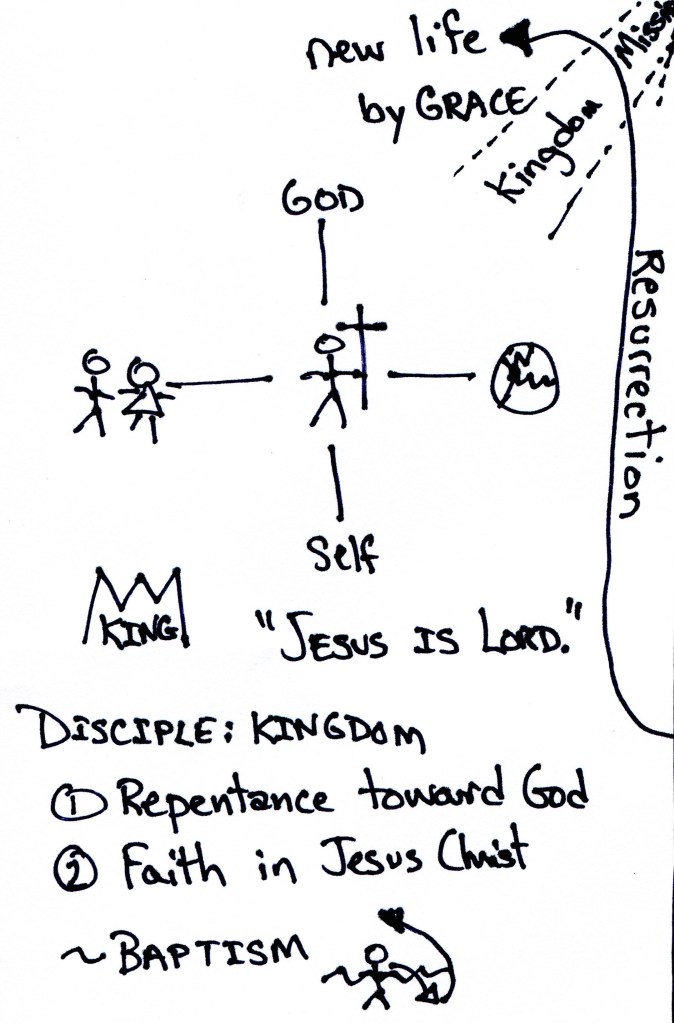
Four Relationships - Gospel Shaped View

1 The earth is the Lord’s and the fullness thereof, the world and those who dwell therein, 2for he has founded it upon the seas and established it upon the rivers.

3 Who shall ascend the hill of the Lord? And who shall stand in his holy place? 4 He who has clean hands and a pure heart, who does not lift up his soul to what is false and does not swear deceitfully. 5He will receive blessing from the Lord and righteousness from the God of his salvation. 6Such is the generation of those who seek him, who seek the face of the God of Jacob.  Psalm 24:1-6

The Stuff of Earth and Conflict
The piercing cries of pain and dismay where the first sign that something was wrong. Then the kids came spilling around the corner into the kitchen. “He won’t share.” “She is grabbing.” “I want a turn.” “It’s mine.”

“It’s yours to share.”

How do you teach children to share or to respect the boundaries of another person without simultaneously crushing their spirit and sense of personal responsibility? My wife and I landed on these words. “It’s yours to share.” This simple phrase opened up the conversation with our children when they ran into the conflict of sharing and wanting. They were empowered to decide with a Gospel-shaped axiom and without our dictatorial intervention. Sometimes it worked!

Authentic stewardship must not ultimately be concerned with rights. The concern for the follower of Jesus is a matter of “to whom does it all belong?”

“The earth is the Lord’s and the fullness therein.”  Psalm 24:1

It all belongs to God.
Christian stewardship casts the stuff of earth into the realm of responsibility: It all belongs to God; We are stewards. The Cross brings us forward into a redemptive work and enjoyment: The Father above has given all good things; we can enjoy and care for others in the distribution of these gifts. But, when it comes to the stuff of earth our sense of security and status have become snared in the thorns and thistles of identity; It too a Saviour on the Cross with a crown of thorns to bring freedom to our hearts.

A blessing for the generation that seeks the God of Jacob.
Jacob (Genesis 25 -33) was blessed with the stuff of earth, rights, and responsibilities. But his maturity lagged behind his accumulation of power. I believe its important that we smile with knowing amazement at the grace of God when the Scripture references the “God of Jacob.” (Psalm 24:6) Don’t just glide past those words.

Jacob the trickster finally become a mature person moving beyond the anxiety that controlled him and his relationships. He eventually became less motivated by an obsession to secure his life and stuff through manuevering and manipulations. It took a vision of heaven. It took being tricked by a trickster as conniving as him. It took a looming crisis of confrontation with his brother. It took a night of wrestling with God! It took time and struggle! But God, God was graceful toward him.

Discipleship and the Stuff of Earth
Authentic Stewardship has to answer the question of WHO? All this is from God. God has ultimate right and authority for it all. The stuff of earth—air, water, land, resources, wealth, wisdom, knowledge and the technology developed from it—is not mine first. It’s God’s. A Gospel-shaped vision of you and me and the stuff of earth will embrace the discipleship journey of learning to be a faithful steward who honours God and people in the way we handle what has been entrusted to us.

Summary thought: your church’s discipleship culture must engage leaders, parents, and employers in a thoughtful obedience to Jesus that includes both the stewardship of people as image-bearers of the Creator and the stuff of earth as that which is ultimately His.  For a time He has seen fit to gift you: It’s yours… to share.

Authentic Worship, Part 1

IMG_9936

1Now when Jesus learned that the Pharisees had heard that Jesus was making and baptizing more disciples than John 2(although Jesus himself did not baptize, but only his disciples), 3he left Judea and departed again for Galilee. 4And he had to pass through Samaria. 5So he came to a town of Samaria called Sychar, near the field that Jacob had given to his son Joseph. 6Jacob’s well was there; so Jesus, wearied as he was from his journey, was sitting beside the well. It was about the sixth hour.

7A woman from Samaria came to draw water. Jesus said to her, “Give me a drink.” 8(For his disciples had gone away into the city to buy food.) 9The Samaritan woman said to him, “How is it that you, a Jew, ask for a drink from me, a woman of Samaria?” (For Jews have no dealings with Samaritans.) 10Jesus answered her, “If you knew the gift of God, and who it is that is saying to you, ‘Give me a drink,’ you would have asked him, and he would have given you living water.” John 4:1-10

Jesus did not have to go through Samaria because of geographic necessity. His compulsion to go through Samaria contradicted the prevailing pathways of his fellow Jews. Samaria was most often avoided by them. But not by Jesus.

“He had to pass through Samaria.”

Why?

In union with the Father and the Spirit Jesus was doing His Father’s work, seeking true worshippers.  He later says to this Samaritan women, “…the hour is coming, and is now here, when the true worshipers will worship the Father in spirit and truth, for the Father is seeking such people to worship him.” (Luke 4:23)

Jesus crossed cultural boundaries and conventions as The Seeker. Authentic worship begins with God’s initiative. God is seeking people who will worship Him in truth and spirit. He has crossed heaven and earth in order to get to you.

Anger after the sun goes down.

IMG_8912

26Be angry and do not sin; do not let the sun go down on your anger, 27and give no opportunity to the devil. Ephesians 4:26-27

So angry. Seething. When the sun goes down on our anger, the mind races to create stories justifying our wrath. The mind creates an enemy not just out of the offending people or group, but out of you. An enemy is one we think the world could do without. In other words, an enemy is one who believes the world would be better if this person was gone, removed, and dead to us. After dark, anger can turn us into the enemy willing and capable of harm. Oh, we might not kill the person, but we can act badly — lashing out later or turning on a cold hearted and deathly silence.

Such mental work is poison to our souls and for our relationships. The Gospel of Jesus compels us to take these matters of anger seriously. We must begin to see anger as an important emotion, signalling that something is wrong either in the world or in us… or in both.

Paul connects “going to bed with anger at play in our heart and mind” as the Devil’s playground. Anger gives the Devil an opportunity.

So you are angry. A work of prayer is required. A work of reconciliation is required too. You must make an intentional decision to keep the offence and problem that stimulated your anger in the light of the Son of God and not in the heart of darkness.