Live like an exile: Live Sent!

IMG_8992

4“Thus says the Lord of hosts, the God of Israel, to all the exiles whom I have sent into exile from Jerusalem to Babylon…  Jeremiah 29:4

The Israelites having been dragged from their homes in Jerusalem and force-marched to Babylon by Nebuchadnezzar were longing for home. Their itching ears grasped hold of every voice that promised a quick return. But Jeremiah basically tells them to let it go. God has sent them.

God sent them to Babylon.

In Christian discipleship the theme of “exile” challenges us to live sent. We are longing for a home where all goes well. But now we are what Peter called “sojourners and exiles.” (1 Peter 2:11) We could just bide our time and tread water, taking what we can from the world. But Jesus will not have it that way. God always has His exiles formed with the word, “sent.”

I sent you.

If God sends us into a wilderness, a city, a difficulty, a workplace, a church, a nation, a campus or even our hometown, He sends us with a purpose. There we can get to know Him. There we can see Him form our heart and character for His purposes. There we be a part of His plan for people. There we can announce the extraordinary good news of God. Its at this point that we must have a proper view of the One who sends us.

Jesus says, “As the Father has sent me, I am sending you.” (John 20:21)

We’ve been sent as servants of the crucified King, the Lamb of God, the Shepherd of our souls.

Live like an exile; live sent.

Live like an exile: God’s got a plan for my future.

searching-300x203

10“For thus says the Lord: When seventy years are completed for Babylon, I will visit you, and I will fulfill to you my promise and bring you back to this place. 11For I know the plans I have for you, declares the Lord, plans for welfare and not for evil, to give you a future and a hope. 12Then you will call upon me and come and pray to me, and I will hear you. 13You will seek me and find me, when you seek me with all your heart. 14I will be found by you, declares the Lord, and I will restore your fortunes and gather you from all the nations and all the places where I have driven you, declares the Lord, and I will bring you back to the place from which I sent you into exile.

Jeremiah sent a letter from Jerusalem to the exiles in Babylon. They where itching to be done with the captivity King Nebuchadnezzar had forced on them. I imagine they got to the end of the letter and where shocked. Then they had to read it again. But the word that would have sent them back to the top would have been what he put at the end.

“When seventy years are completed for Babylon, I will visit you, and I will fulfill to you my promise and bring you back to this place. 11For I know the plans I have for you, declares the Lord, plans for welfare and not for evil, to give you a future and a hope.”

Bad news. Good news.

You are going to be in Babylon for 70 years.  Then, I will bring you home.

God raises the issue of trust about the future.

Are you trusting the One who holds your future? He says, “ I know the plans I have for you, plans for welfare and not for evil, to give you a future and a hope.”

We long for a home properly ruled by The King Jesus. We are not there yet. But even now, we live under His graceful rule. As the church we live like exiles as the people of His Kingdom. Our hope for the future resides not in the inventions, wisdom or economies of people but in the presence of our King with us now.

So we live like an exile. We engage in the world today because our hope is secured in Christ Jesus. We live like all the great people of faith described in Hebrews 11:
Hebrews 11:13-16

13These all died in faith, not having received the things promised, but having seen them and greeted them from afar, and having acknowledged that they were strangers and exiles on the earth. 14For people who speak thus make it clear that they are seeking a homeland. 15If they had been thinking of that land from which they had gone out, they would have had opportunity to return. 16But as it is, they desire a better country, that is, a heavenly one. Therefore God is not ashamed to be called their God, for he has prepared for them a city.

The Handle is on Your Side

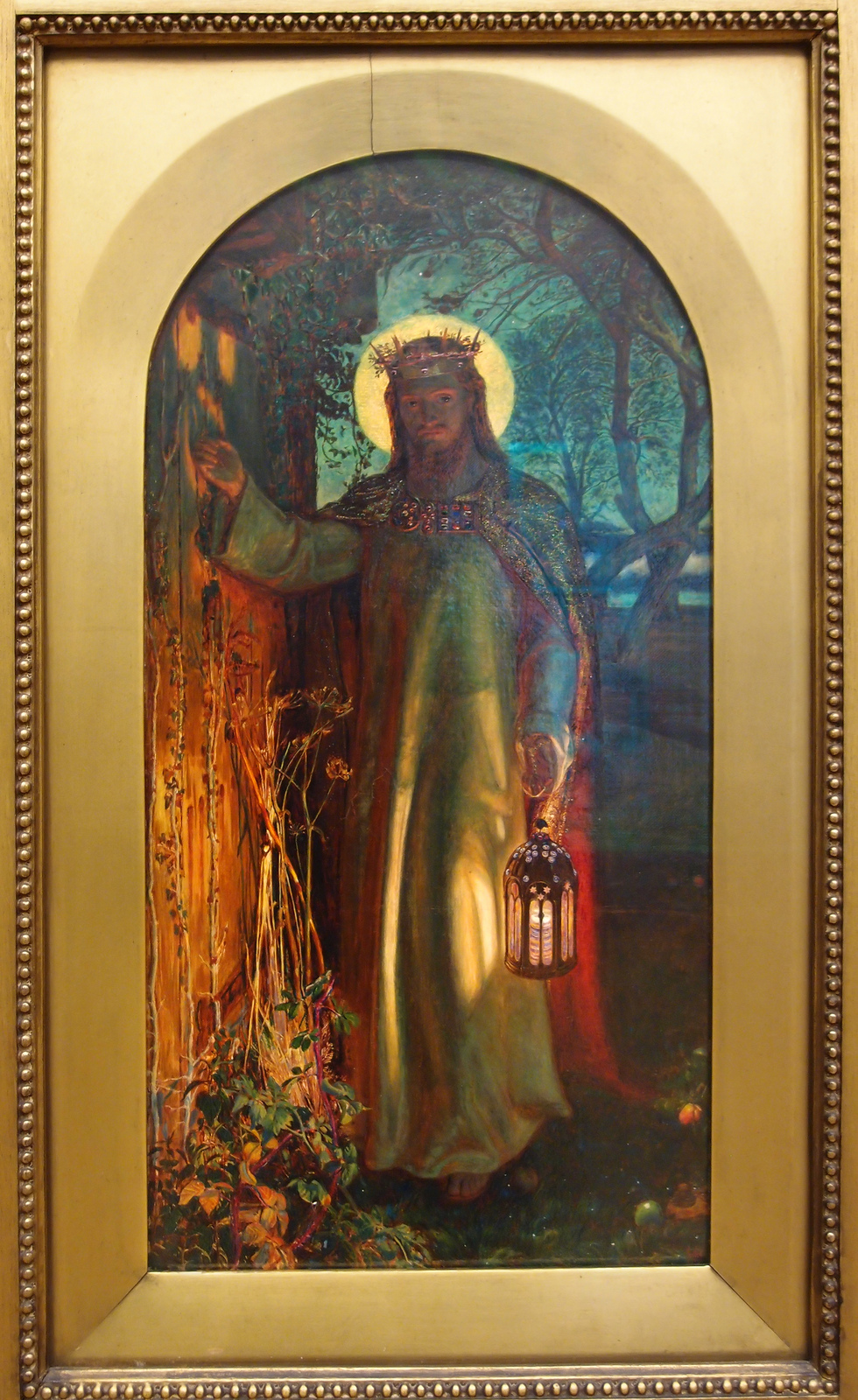
Light of the World, William Holman Hunt

20Behold, I stand at the door and knock. If anyone hears my voice and opens the door, I will come in to him and eat with him, and he with me. 21The one who conquers, I will grant him to sit with me on my throne, as I also conquered and sat down with my Father on his throne. 22He who has an ear, let him hear what the Spirit says to the churches.’”

Revelation 3:20-22

Until its a habit, its a battle, its a struggle to meet Jesus heart to heart. Well its a struggle even then. Jesus address believers in the Church of Laodicea and invites them to open the door of the heart to Him. He uses the language of war to describe the situation. “The one who conquers, I will grant him to sit with me on my throne, as I also conquered and sat down with my Father on his throne.” You see Jesus gave up His chair in heaven for a time in order to take up a cross and open the way for you to meet Him.

But.

The handle to this door is on your side. Jesus knocks. You get to answer.

William Holman Hunt, painted a famous allegorical scene, in which a door long unopened has Jesus the light of the world, standing, and knocking at the door. Jesus comes to meet you. He knocks. He waits.

He will come in and commune with you. Enter the struggle. Set a time, a place, and build the habit of opening His Word and your heart to Him.

Our Courageous Saviour Painted in Shades of Shame

IMG_7289 - Version 210The thief comes only to steal and kill and destroy. I came that they may have life and have it abundantly. 11I am the good shepherd. The good shepherd lays down his life for the sheep. 12He who is a hired hand and not a shepherd, who does not own the sheep, sees the wolf coming and leaves the sheep and flees, and the wolf snatches them and scatters them. 13He flees because he is a hired hand and cares nothing for the sheep. 14I am the good shepherd. I know my own and my own know me, 15just as the Father knows me and I know the Father; and I lay down my life for the sheep.

John 10:1-15

Perhaps you don’t see yourself in the centre of a conflict. Jesus does. In John 10 Jesus describes the human condition with the metaphor of sheep. The thief, the wolf, (Satan) comes to steal, kill and destroy sheep. Jesus comes to give life, abundant life to the sheep. Hired hands would run away from the cost of winning this conflict. But not Jesus, He is the good shepherd; He lays down His life for the sheep. He lays down His life for you.

Jesus is the courageous Saviour. Laying down His life required a cross. A cross was not the typical vision of courage. Such a death would have been painted in shades of sinful shame. And yet, Jesus decided the will of the Father’s love for you and me was worth it. You are immensely valuable to God. It took a courageous Saviour Shepherd, Jesus to show us.

1Therefore, since we are surrounded by so great a cloud of witnesses, let us also lay aside every weight, and sin which clings so closely, and let us run with endurance the race that is set before us, 2looking to Jesus, the founder and perfecter of our faith, who for the joy that was set before him endured the cross, despising the shame, and is seated at the right hand of the throne of God. 3 Consider him who endured from sinners such hostility against himself, so that you may not grow weary or fainthearted.
(Hebrews 12:1-2)

NT Wright on Prayer & Holiness

IMG_4526

I’ve been reading N.T. Wright’s book, After you Believe: Why Christian Character Matters. I keep returning to his discussion of Romans 8:12-17. Absolutely beautiful! My systematic theology professor, use to say our generation had one of the most under-developed eschatological visions ever. N.T. Wright is out to change that.


After You Believe, p. 93-95. (Harper One, 2010, paperback)

So the telos, the “goal” of being “glorified” over the creation, is to be anticipated in the present by replacing the slave-habits of mind, heart and body with freedom-habits—habits that both share in God’s freedom themselves and bring that freedom to the world. That is, more or less, what Paul understands by holiness or sanctification, the learning in the present of the habits which anticipate the ultimate future. But that sovereign and redemptive rule of renewed humans over God’s world is also anticipated in the present time through prayer.

The whole creation, he says, is groaning in labor pains, longing for the birth of the new creation from the womb of the old (8.22). We ourselves, within that creation, find ourselves growing as we await our own “adoption as sons and daughters, the redemption of our bodies” (8.23) But precisely in that state, as we are longing for and anticipating the final “glorification,” the Spirit is also at work within us, “groaning without words,” and thus enabling us, even when we don’t know what to pray for as we ought, nevertheless to be interceding for the whole world (8.26-27). This essentially priestly vocation, standing before God with his whole creation on our hearts, joins up with the vision of royal sovereignty over creation, and is one of its key aspects. This passage offers one of the strangest but also most moving descriptions in the whole New Testament of what the Christian understands by prayer: the inarticulate groaning in which the pain of the world is felt most keenly at the point where it is also being brought, by the Spirit, in the very presence of God the creator. This is central, in the present time, to the entire human vocation. Learning this language is the second key habit which forms the pathway to the eventual goal, the goal of “royal priesthood.”

In other words, the present anticipation of the future glory consists not in lording it over creation, imagining ourselves already its masters, able to tyrannize it and bend it to our will. It consist, rather, in the humble, Christlike, Spirit-led activity of prayer, the prayer in which the love of God is poured into our hearts by the Spirit (5.5) so that the extraordinary and almost unbelievable hope that is set before us is nevertheless firm and secure (5.1-5; 89.28-30). Thus, at the heart of arguable the greatest chapter of certainly his greatest letter, Paul sets out the pattern of present anticipation of future hope. This is what virtue is all about. The hope is that all those who are “in Christ’ and are indwelt by the Spirit will eventually reign in glory over the whole creation, thereby taking up at long last the role commanded for humans in Genesis 1 and Psalm 8 and sharing the inheritance, and the final rescuing work, of the Messiah himself, as in Psalm 2. And if that is the telos, the goal, it is to be anticipated in the present by the settled habits of holiness and prayer.