Personal Thoughts on Dalai Lama Center, Peace Summit, Vancouver 2009

In a few days Vancouver will be inundated with people who have demonstrated with their life a commitment to improving the lives of others and building a life of peace.  The Peace Summit, Vancouver 2009, sponsored by the Dalai Lama Center in Vancouver has drawn together an extraordinary group of people for dialogue in both public and private conversations. The Epoch times has an informative article listing and describing the participants which include the Dalai Lama, and Noble Peace Prize Laureates, Desmond Tutu, Jody Williams, and Mairead Maguire.

I was recently asked what I thought about the event.  Here are a few personal observations and the perspectives that shape them–just looking in before it gets started:

1.  The Summit is a remarkable celebration of LIBERTY.  As a philosophical construct informed from a Christian worldview, liberty demands that people be free to hold exclusive and divergent positions or truth claims while maintaining the dignity and high value of all humanity in respectful interactions.  Where liberty is most graciously practiced tension abounds–especially for those who observe people with divergent truth-claims getting along and planning to do good together.

2.  The Summit promotes the difficult task of PEACEMAKING.  The values and competencies required to make peace in a world of hostility will be discussed and made available through the event.  Relational reconciliation begins in our own neighbourhoods and cities.  To break dividing walls of hostility is not an easy task and requires “wisdom from heaven.”  Jesus calls his followers to respond to His grace with lives that promote peace; he said, “Blessed are the peacemakers, for they will be called sons of God.”  And James writes,

13 Who is wise and understanding among you? Let him show it by his good life, by deeds done in the humility that comes from wisdom. 14 But if you harbor bitter envy and selfish ambition in your hearts, do not boast about it or deny the truth. 15 Such “wisdom” does not come down from heaven but is earthly, unspiritual, of the devil. 16 For where you have envy and selfish ambition, there you find disorder and every evil practice.

17 But the wisdom that comes from heaven is first of all pure; then peace-loving, considerate, submissive, full of mercy and good fruit, impartial and sincere. 18 Peacemakers who sow in peace raise a harvest of righteousness.  NIV (James 3:13-18)

3.  The Summit is a reflection of COMMON GRACE.  From the perspective of a Christian worldview I see the Peace Summit as a possibility only because of God’s gracious kindness toward all humanity who desires that all would come to repentance and faith in Jesus Christ.  Notice the gift of peace for people that Christians are to seek in prayer as described in 1 Timothy 2:1-6

2:1 I urge, then, first of all, that requests, prayers, intercession and thanksgiving be made for everyone- 2 for kings and all those in authority, that we may live peaceful and quiet lives in all godliness and holiness. 3 This is good, and pleases God our Savior, 4 who wants all men to be saved and to come to a knowledge of the truth. 5 For there is one God and one mediator between God and men, the man Christ Jesus, 6 who gave himself as a ransom for all men-the testimony given in its proper time.  (NIV)

2:1 I urge, then, first of all, that requests, prayers, intercession and thanksgiving be made for everyone- 2 for kings and all those in authority, that we may live peaceful and quiet lives in all godliness and holiness. 3 This is good, and pleases God our Savior, 4 who wants all men to be saved and to come to a knowledge of the truth. 5 For there is one God and one mediator between God and men, the man Christ Jesus, 6 who gave himself as a ransom for all men-the testimony given in its proper time.
NIV

4.  The Summit is a RELIGIOUS event.  Participants, including the Dalai Lama come to the Summit from their own worldview and construct of faith either in themselves, or a set of principles greater themselves, or in a god.  If we understand spirituality as the pursuit required to integrate what we see with what we don’t see then one could say this is a SPIRITUAL event as well.  James, the half-brother of Jesus, writes to the churches that “Religion God our Father accepts as pure and faultless is this:  to look after orphans and widows in their distress and to keep oneself from being polluted by the world.” (James 1:27)  Religion though is most often an exercise in self-justification, self-righteousness, and self-awareness.  When either of these selves is threatened it turns quickly to the desires for power and control in order to maintain this idolatry or balance of a self-satisfied life.  A spirituality flowing out of the Gospel of Jesus Christ will be categorically different in its realization that justification, righteousness and awareness are secured in Christ.  As a resident of a City (Vancouver) that has many who long to be good, I can observe with the Apostle Paul that God has worked in the hearts of humanity a record of His Law or way:  “Indeed, when Gentiles, who do not have the law, do by nature things required by the law, they are a law for themselves, even though they do not have the law, since they show that the requirements of the law are written on their hearts, their consciences also bearing witness, and their thoughts now accusing , now even defending them.”  (Romans 2:14-15)  One of the stated goals of the Dalai Lama Center for Peace and Education is the “education of the heart;” participants will be encouraged to explore and develop personal peace from which will hopefully flow compassion for others; that’s religion at its best.  Not a GOSPEL event but a RELIGIOUS event.

5.  The Peace Summit reminds me of the SUPREMACY OF CHRIST.  The followers of Jesus even from the first century have entered into the real and sometimes figurative Areopagus (See Acts 17:16-34)  in order to proclaim the reality and the meaning of the resurrection of Jesus Christ.  The exchange of ideas in the marketplace is exciting and sometimes costly.  Love and Truth do mix.  Our Vancouver- Canadian apprehension of conflict will be challenged by the public exchange of ideas that the Peace Summit elicits.  From the Christian worldview, Christians live their lives in response to Jesus Christ because of His “work” on the cross and His resurrection that confirmed and completed His work.  Jesus is our Prince of Peace.  He brings a peace that the world cannot give.  He brings a peace with God that transcends all other realities.  I don’t want to pretend about the realities of conflict like those who say, “Peace, Peace, where there is no peace.”  (See Jeremiah 6:14)  The claims of Christ are in direct conflict with the dominant messages of spiritual self-sufficiency.  The Apostles who functioned in a world of diverse ideas and claims to truth show us how to live as followers of Jesus Christ:  test the spirits, discern the truth, act in love.    See 1 John 4:1-21 below.

4:1 Dear friends, do not believe every spirit, but test the spirits to see whether they are from God, because many false prophets have gone out into the world. 2 This is how you can recognize the Spirit of God: Every spirit that acknowledges that Jesus Christ has come in the flesh is from God, 3 but every spirit that does not acknowledge Jesus is not from God. This is the spirit of the antichrist, which you have heard is coming and even now is already in the world.

4 You, dear children, are from God and have overcome them, because the one who is in you is greater than the one who is in the world. 5 They are from the world and therefore speak from the viewpoint of the world, and the world listens to them. 6 We are from God, and whoever knows God listens to us; but whoever is not from God does not listen to us. This is how we recognize the Spirit of truth and the spirit of falsehood.

7 Dear friends, let us love one another, for love comes from God. Everyone who loves has been born of God and knows God. 8 Whoever does not love does not know God, because God is love. 9 This is how God showed his love among us: He sent his one and only Son into the world that we might live through him. 10 This is love: not that we loved God, but that he loved us and sent his Son as an atoning sacrifice for our sins. 11 Dear friends, since God so loved us, we also ought to love one another. 12 No one has ever seen God; but if we love one another, God lives in us and his love is made complete in us.

13 We know that we live in him and he in us, because he has given us of his Spirit. 14 And we have seen and testify that the Father has sent his Son to be the Savior of the world. 15 If anyone acknowledges that Jesus is the Son of God, God lives in him and he in God. 16 And so we know and rely on the love God has for us.

God is love. Whoever lives in love lives in God, and God in him. 17 In this way, love is made complete among us so that we will have confidence on the day of judgment, because in this world we are like him. 18 There is no fear in love. But perfect love drives out fear, because fear has to do with punishment. The one who fears is not made perfect in love.

19 We love because he first loved us. 20 If anyone says, “I love God,” yet hates his brother, he is a liar. For anyone who does not love his brother, whom he has seen, cannot love God, whom he has not seen. 21 And he has given us this command: Whoever loves God must also love his brother.  NIV

Recent articles:

Vancouver Sun writer Douglas Todd explores the three goals of the Peace Summit.
integrity test: resolving the clash of wills

In the last of the Integrity Test series, we considered what happens when there is a clash of wills.  Human life under the creative hand of God means that we live with the power to choose the attitudes and actions of our lives.  Jesus had a share in this trait as well.  In Luke 22:39-46, Luke presents his audience with Jesus’ conflict of will between what he wanted and what he understood his Heavenly Father wanted.  In the journey to the cross we must understand that Jesus did not have a death wish nor a desire to enter into the anguish of humanity’s sin and guilt–the very product of our lack of integrity with God.  However, Jesus did intend to live in union and obedience with His Heavenly Father and the Holy Spirit.  Like Jesus, I find myself in a clash of wills when my intention to join God in what He is doing in the world conflicts with my natural inclination to preserve myself, to avoid pain, suffering, and discomfort by holding onto comfort, ease, the familiar, the safe, and the secure.  Here are few examples of when you might experience this kind of clash of wills:  when you know honesty with a parent or spouse will transform the relationship, when you are going to have to give away or sell your stuff in order to give to another, when you need to change your career path to pursue a passion and opportunity to serve that God has shown you, when you must parent with patience a child who is struggling, when you need to tell him or her “no,” when you are going to intervene in a conflicted and angry situation as a peacemaker, when you have to use your holiday to go on a mission trip, when you must wake-up every day and enter into routines with love, when you must keep investing in a covenantal relationship when you don’t feel like you are getting anything out of it, when you need to add a new discipline to your life in order to pursue God.

Now it is a different thing when the clash of wills is because of what I am doing in the world as an act of rebellion or even thoughtlessness of what God wants.  This message is really concerned with what happens when we have the good intentions required to join God in what He is doing in the world.  Jesus shows us that the clash of wills is resolved in prayer.  (You can listen to the audio of this message, When you have a clash of wills, later in the week from Cityview.)

Text:  Luke 22:39-46

Big Idea:  The clash of wills is resolved in prayer.

Unpacking the Text:

1. Jesus lived his life in communion with the Heavenly Father and the Holy Spirit and in the company of those He called.

       “Jesus went as usual to the Mount of Olives and his disciples followed him.”  Luke 22:39

2. Jesus’ conflict with the will of the Father arises from His Trinitarian communion and from His intention to do the will of the Father in the face of painful and terrifying realities.

      “Father if you are willing, take this cup from me; yet not my will, but yours be done.”  Luke 22:42

Jesus has already made reference to His Father’s will on this very evening by casting a look back to the Old Testament.  Here, Luke 22:42, “this cup” brings to mind the prophetic announcements of God’s cup of judgment for sin.  It is now finding its fulfillment in Jesus and the cross.  In Luke 22:37, Jesus quotes Isaiah 53 and identifies himself as The Suffering Servant, “It is written: ‘And he was numbered with the transgressors;’ and I tell you that this must be fulfilled in me.  Yes, what is written about me is reaching its fulfillment.”

We must beware the path of least resistance.

On Sunday I did not mention Alex and Brett Harris.  However I include their material here as a good resource to anyone who would like to explore further the idea of “doing the hard thing.”  Though they are writing and targeting their message for a generation of teenagers, I have been inspired and encouraged by the revebelution they envision.  Check out their website & blog, read their book–Do Hard Things, and watch the following video to get the gest of their message.


3. Jesus knows the disciples lack the resources in themselves alone  to be victorious in the clash of wills and commands them to pray.

       “Pray that you will not fall into temptation.”  Luke 22:46

4.  If you intend to join God in what He is doing to love the world and restore people into fellowship with Him, you will have to do the hard thing.  If you intend to do the hard thing, you will have to constantly realign your will with His through the communion, conversation and cry of prayer.


In the preservice count down at Cityview we showed a video featuring Steven Curtis Chapman’s redition of Matt Redman’s song “Yours.”  In it he includes a verse written after the devasting loss of his adopted daughter Maria, when she was struck and killed when his 17 year old son was backing the family car out of the driveway.  After much prayer and counsel Chapman returned to his tour to promote his newest album.

Notice how Chapman found resolution to his clash of wills.  How could he join God in what He was doing in the world when his own heart was so grieved and torn?  Elizabeth Diffin, a reporter who attended one of Chapman’s concerts writes:

“Blessed be your name” was the first song Chapman sang May 21, the day of Maria’s death, when he wasn’t sure he’d ever be able to sing again.  Inspired by the story of Job, at one point the lyrics repeat, “He gives and takes away.”  “As I sang this song…it wasn’t a song, it was a cry, a scream, a prayer,” Chapman explained to the audience.  “I found an amazing confort and peace that surpasses all understanding.”

Chapman also shared that after Maria’s death, he’d reconsidered the words to all his songs and whether he could still sing–and believe–them.  Instead, losing his little girl brought the meaning of some of those songs into sharper focus.  One example was “your” which addresses how everything in the world belongs to God.  “In this song in particular, I had to come to a new realization” he said.  “There’s not an inch of creation that God doesn’t look at and say ‘all that’s mine.”  As a result of that realization in conjunction with Maria’s death, Chapman added a new verse to “Yours”:

I’ve walked the valley of death’s shadow
so deep and dark that I could barely breath.
I’ve had to let go of more than I could bear and
I’ve questioned everything that I believe.
Still even here in this great darkness
a comfort and a hope comes breaking through
as I can say in life or death
God we belong to you. 

Steven Curtis Chapman Explains the new verse

“Yours” as seen Sunday


The clash of wills is resolved in prayer.

“Do not be anxious about anything, but in everything, by prayer and petition, with thanksgiving, present your requests to God.  And the peace of God, which transcends all understanding, will guard your hearts and your minds in Christ Jesus.”  Philippians 4:6-7

centering prayer

Last night Ellen and I watched Tony Campolo on DVD from his Sunday talk at  Mission Fest 2009.  Just as I was moved at his Friday night talk I was moved in this one on the topic of prayer and missions.  Tony spoke of a return to “ancient prayer” models that had been developed and taught in the Catholic stream.  Centering prayer has been most helpful to him.  In an article for Beliefnet he writes:

Today, some of the most spiritual people I know claim to be without religion.

I relate to their problem. I have experienced an unspoken dissatisfaction with own my spiritual life that has only been allayed over the past few years as my prayer life began to change. Believing the gospel was never a problem for me, but during times of reflection I sensed that believing in Jesus and living out His teachings just wasn’t enough. There was a yearning for something more, and I found that I was increasingly spiritually gratified as I adopted older ways of praying–ways that have largely been ignored by those of us in the Protestant tradition. Counter-Reformation saints like Ignatius of Loyola have become important sources of help as I have begun to learn from them modes of contemplative prayer. I practice what is known as “centering prayer,” in which a sacred word is repeated as a way to be in God’s presence. 

If you would like to know more continue reading his article or listen to Thomas Keating teach on the topic.  I have found that some songs helpful to me in centering prayer and I have posted, Jesus-be the centre, below.  Meeting with Jesus, sitting with Jesus, is often hard for the activist bent I live with.  While working on my Dmin, Dr. Nelson said that Baptists must learn to be “active contemplatives.”  I’m still learning.

Thomas Keating on Centering Prayer
 

Jesus, be the center…

integrity test: will I stand with the friends of Jesus?

Here’s the reality:  there are forces subtly and not so subtly arraigned to divide the friends of Jesus from Him and from each other.  The disciples experienced this pressure early on when Jesus called Levi, the tax collector to follow Him.

Jesus went out and saw a tax collector by the name of Levi sitting at his tax booth.  “Follow me,” Jesus said to him, and Levi got up, left everything and followed him.  Then Levi held a great banquet for Jesus at his house, and a large crowd of tax collectors and others were eating with them.  But the Pharisees and the teachers of the law who belonged to their sect complained to his disciples, “Why do you eat and drink with tax collectors and ‘sinners.’?”  Jesus answered them, “It is not the healthy who need a doctor, but the sick.  I have not come to call the righteous, but sinners to repentance.”  Luke 5:27-32

The party has been crashed.  The Pharisees are making a scene.  And Matthew (Levi) stands to be embarrassed.  Perhaps the music stopped and everyone gets quiet to see what would happen next.  Its Matthew’s party…but its Jesus who gets in the face of the Pharisees and challenges their self-righteousness with a statement of defence crafted not on the merits of the tax collectors and sinners, but rather on the merits of His own mission.  Jesus will not be divided from the people He has called out even when others call them down.

In our setting, self-righteousness comes in many forms and has many preachers.  The “new” self-righteousness may not be religious, but may actually pride itself in not being religious.  This self-righteous non-religiosity creates a pressure that can divide many followers of Jesus from living an integrated life.  It happens on Monday morning.  “Hey, how was your weekend.”  Great.  “What did you do?”  uhm…watched the game, went hiking with the family…

What’s missing?  A vibrant confession:  “I got to hang out with some friends who have been accepted by Jesus Christ and consider how God is making a difference in… I’m amazed that this group of imperfect, diverse, people are drawn to Jesus and have been given life.  I’m really happy to be a part of this group.”  

Or whatever…but that’s the integrity test.  Its in the subtle ways we avoid pressure, question, conflict, and therefore never create the space to address one of the hot deafeaters of faith in Jesus:  the weaknesses and failings of Jesus’ own people.  Unless we confess with absolute joy and awe at what Jesus has done in accepting us–all of us who call Him Lord, then we will rarely have the opportunity to proclaim the gospel as a way of living that is neighter religious or irreligious, moral or immoral.  Unless we celebrate the mission of Jesus to us–to meet the sick and to heal them–and to call the sinners to repentance–then we will struggle on Mondays and Tuesdays and Fridays–and even Sundays to stand with the church.

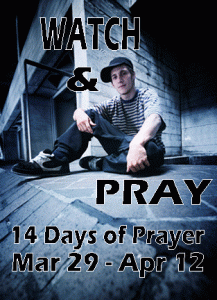
watch & pray with Cityview, Mar 29 – Apr 12

watch-prayIn the fourteen days leading up to Easter Cityview is uniting with a few other local congregations in 14 days of prayer.  I want to encourage you to take up the challenge of getting together with two other people for a period of united prayer.  Our heavenly Father delights to answer prayer and there are things He desires to do in your life when you will maintain a posture of prayer.  On many occasions Jesus instructed his disciples in the prayer life.  In fact Jesus told more than one parable to encourage boldness and persistence in prayer.

“Suppose one of you has a friend, and he goes to him at midnight and says, ‘Friend lend me three loaves of bread, because a friend of mine on a journey has come to me, and I have nothing to set before him.’  Then the one inside answers, ‘Don’t bother me.  The door is already locked, and my children are with me in bed.  I can’t get up and give you anything.’  I tell you, though he will not get up and give him the bread because he is his friend, yet because of the man’s boldness, he will get up and give him as much as he needs.”

“So I say to you:  Ask and it will be given to you; seek and you will find; knock and the door will be opened to you.  For everyone who asks receives; he who seeks finds; and to him who knocks the door will be opened.”

“Which of you fathers, if your son asks for a fish, will give him a snake instead?  Of if he asks for an egg, will you give him a scorpion?  If you then, though you are evil, know how to give good gifts to your children, how much more will your Father in heaven give the Holy Spirit to those who ask him!”
Luke 11: 5-13

Some suggestions for how to get the most out of these 14 days of prayer are below.


 · Develop your prayer team of 3 people now.

· Meet together to develop your prayer list by Mar 28; see the prayer guide for directions.

· Submit your list to Pastor Craig for his private prayer by March 29.

· Connect daily over the 2 week period for prayer.

· Meet as a prayer team at the two pubic gatherings.
          Tuesday March 31 & Tuesday April 7, 7:00 PM

· Watch for God’s response.

Here are few suggestions for your prayer list.  Divide it into three parts.  Lift these requests and those of your 2 other prayer partners up to God persistently for the two week period.

ASK for God to provide for personal / family needs.  Identify 2 or 3 needs.

SEEK for God’s direction for a decision or intervention in a situation.  Identify 1or 2 decisions or situations.

KNOCK for God’s salvation for friends, neighbours, coworkers or family that have not yet entered into a personal relationship with Jesus Christ.  Identify 3 or 4 people.

Cityview will also publish a prayer list specific to the organization needs of our sister churches and congregations that are participating in the two week prayer emphasis.

This year on the journey to Easter WATCH & PRAY.