Your love choice.

IMG_7907

15The Lord God placed the man in the Garden of Eden to tend and watch over it. 16But the Lord God warned him, “You may freely eat the fruit of every tree in the garden—17except the tree of the knowledge of good and evil. If you eat its fruit, you are sure to die.” Genesis 2:15-17

This tree of the knowledge of good and evil appears to be the problem when we look back through the lens of our suffering and evil. Why did God do this? The tree is the hinge on which love turns. God created humanity with capacity and opportunity to choose love. So it is with the “image of God.” Love maintains a mixture of awe and respect with trust. Love cherishes the other. Love enters communion. These are all choices. Without “the tree” there are no choices and humanity resides in the garden as automatons, puppets on a string, acting only within a predetermined script.

Just as relationship within the communion of God is dynamic; so relationship between God and those who bear His image is dynamic.

Love for God is to live in respect to God with trust in Him and in His Word. The image of God has been bestowed on us and with it comes both capacity and responsibility to choose.


Relationships without shame.

IMG_2117

18Then the Lord God said, “It is not good for the man to be alone. I will make a helper who is just right for him.” 19So the Lord God formed from the ground all the wild animals and all the birds of the sky. He brought them to the man to see what he would call them, and the man chose a name for each one. 20He gave names to all the livestock, all the birds of the sky, and all the wild animals. But still there was no helper just right for him.

21So the Lord God caused the man to fall into a deep sleep. While the man slept, the Lord God took out one of the man’s ribs and closed up the opening. 22Then the Lord God made a woman from the rib, and he brought her to the man.

23“At last!” the man exclaimed.

“This one is bone from my bone,

and flesh from my flesh!

She will be called ‘woman,’

because she was taken from ‘man.’”

24This explains why a man leaves his father and mother and is joined to his wife, and the two are united into one.

25Now the man and his wife were both naked, but they felt no shame. Genesis 2:18-25

Shame hides. Shame creates a compulsion to hide either by overdoing togetherness or separateness. Shame is an enemy of communion. But shame is not the product of separateness or of union.

No shame. We have difficulty imagining such a condition.

God intended for Adam to discover his aloneness or difference from the creation. I believe the naming process created an awareness of self and of the other; or perhaps I should say the naming process engaged Adam with the stuff of earth and created the awareness in Adam of the absence of the “other” who was “just right for him.”

When Adam saw the woman, he recognized and rejoiced in her. His poetic explosion highlights their connection and their separateness. True communion must be permeated with the grace of God; it is the condition required for the strength and glory of an eben-ezer (strong help) to be received and cherished without fear, guilt, or shame. In the backstory of the Gospel its hard for us to imagine relationships without shame.

Created in the image of God.

Sunset 3rd Beach

26Then God said, “Let us make human beings in our image, to be like us. They will reign over the fish in the sea, the birds in the sky, the livestock, all the wild animals on the earth, and the small animals that scurry along the ground.”

27So God created human beings in his own image. In the image of God he created them;

male and female he created them.

28Then God blessed them and said, “Be fruitful and multiply. Fill the earth and govern it. Reign over the fish in the sea, the birds in the sky, and all the animals that scurry along the ground.”  Genesis 1:26-28

The Christian view of humanity before the Great Catastrophe is glorious. God created people. He created people with capacity for relationships, love, and authority.  And God blessed them; He set before them the abundance of earth and set before them the opportunity to delight in Him and in each other and the diversity of creation.

Humanity carries within a fundamental and qualitative difference from the rest of Creation. They have been made “in the image of God.” They have been bestowed with a character representative and related to the Creator separate from the rest of Creation. Yet they are distinctly connected to the Creation for they have been endowed by God with capacity to rule and to choose.

But perhaps more importantly, humanity was created with a capacity for knowing God and living in communion with Him through loving responsive to Him.

We’ve been created for relationships.

IMG_8863

3When I look at the night sky and see the work of your fingers—

the moon and the stars you set in place—

4what are mere mortals that you should think about them,

human beings that you should care for them?

5Yet you made them only a little lower than God

and crowned them with glory and honor.

6You gave them charge of everything you made,

putting all things under their authority—

7the flocks and the herds

and all the wild animals,

8the birds in the sky, the fish in the sea,

and everything that swims the ocean currents.

Psalm 8:3-8

The Christian worldview maintains that God created people for four kinds of relationships: with God, with self, with people, and with the stuff of earth. In this Psalm of David we see this conviction present. David sets himself in Creation—the stuff of earth— and reflects on himself in relationship to God, with people, and in the Creation. All four relationships are in play in this Psalm.

The tension in the Psalm is unavoidable. David is in awe of God. Yet David feels small. God has show Himself large in the immensity of the night sky, the strength of the wild, the seemingly unrestrained space of the sky and sea. And yet, humans matter to God. And yet, God has given mere mortals glory and honour to have authority in the creation.

I’m blessed to come everyday to a community dedicated to the study of the creation and all that humanity has done with it. I am often delighted by the students and professors whose knowledge of slices of The Creation is only bounded by time and the questions they are asking. They are awesome.

Knowing God, the Creator, drives our faith forward to seek and know Him.  The writer of Hebrews says, “It is impossible to please God without faith. Anyone who wants to come to him must believe that God exists and that he rewards those who sincerely seek him.”Hebrews 11:6

We give regard to the Cross because of the One who died there for all.

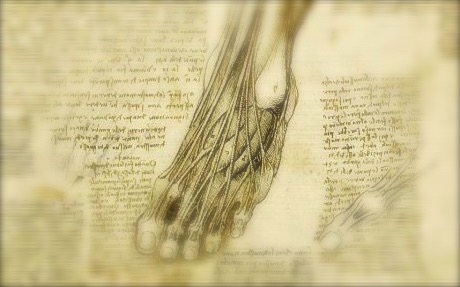
da-vinci-foot_2635775c

He humbled himself in obedience to God and died a criminal’s death on a  cross. Philippians 2:8 (NLT)

The cross was a feared execution stake. It was a place of shame, guilt, and fear. And it meant those very burdens were being bourn in the person nailed there. But Jesus, died a criminal’s death that was not His own. The testimony of Scripture is that Jesus was “without sin” but “became sin” for us. (1 Corinthians 5:21) The cross is the location of that transfer. God was up to something extraordinary there for us! But first it most be considered that Jesus took up the cross in regard to His communion with the Heavenly Father. Jesus is a willful participant in your salvation.

Let’s reflect on Jesus and His Cross. from the context of this from Philippians 2:5-10 —

5… Christ Jesus…

6Though he was God,

he did not think of equality with God

as something to cling to.

7Instead, he gave up his divine privileges;

he took the humble position of a slave

and was born as a human being.

When he appeared in human form,

8he humbled himself in obedience to God

and died a criminal’s death on a cross.

9Therefore, God elevated him to the place of highest honor

and gave him the name above all other names,

10that at the name of Jesus every knee should bow,

in heaven and on earth and under the earth,

11and every tongue declare that Jesus Christ is Lord,

to the glory of God the Father.